
You’ve built something real. You have decades of experience, a proven track record, and clients who love what you do.
But somewhere along the way, newer businesses with less experience and a whole lot more social media posts started showing up where you should be.
And that gap? That’s not about skill. It’s about visibility.
This guide was written specifically for seasoned business owners who are ready to stop being the best-kept secret in their industry and start showing up online — without going live, without dancing on camera, and without starting from scratch.
Below, you’ll learn exactly how to market your small business online using social media and simple AI tools like ChatGPT. Everything you need to close that visibility gap is right below
Table of Contents
📋 Jump to Your Step:
Never Marketed Online? Start Here
If you’ve spent decades building a successful business through word of mouth, referrals, and relationships and online marketing still feels like a foreign language, if this sounds familiar, you’re in exactly the right place. This isn’t about starting over. It’s about adding one powerful layer to everything you’ve already built.
Here’s the truth most marketing gurus won’t tell you: you don’t need to learn everything. You need to learn the RIGHT things in the right order. And that starts with understanding why experienced business owners actually have a massive advantage online that younger competitors simply don’t have yet.
Your advantage is your credibility. You have years of real results, real client wins, and real expertise that no 25-year-old startup can fake. The problem isn’t what you know — it’s that the people who need you most can’t find you online. That’s what we’re fixing right here.
Here’s where to start — 3 things to do before you post anything online:
Step 1 — Decide on ONE platform first. Don’t try to be everywhere. Pick one — Facebook, Pinterest, or LinkedIn — based on where your ideal client already spends time. Seasoned service professionals typically see the fastest results on Facebook and Pinterest.
Step 2 — Set up your profile like a landing page. Your bio, photo, and description should answer three questions immediately: Who do you help? What problem do you solve? What should they do next? Most business owners skip this and wonder why nobody follows them.
Step 3 — Post before you feel ready. The biggest mistake experienced business owners make is waiting until everything is perfect. Your first post doesn’t need to be perfect — it just needs to exist. Momentum beats perfection every single time.
The hardest part isn’t the posting. It’s knowing what to say, how to say it, and how to make it sound like YOU — not a robot. That’s exactly what the right AI setup solves.
Speaking of sounding like yourself online — what if ChatGPT already knew your voice, your audience, and your business well enough to write your content for you? Not generic content. YOUR content.
The kind that sounds like you sat down and wrote it yourself on your best day. That’s not a dream — it’s a setup. And it’s completely free to get started.
Grab the free ChatGPT Cheat Codes for Small Business guide here and see what’s possible before you write your next post.
[BUTTON: Get the Free Guide →] → links to Flodesk
Feeling Left Behind? You’re Not Alone

Let’s be honest about something most marketing content refuses to say out loud.
The online world moved fast and it moved without stopping to explain itself to the people who had already built real, successful businesses the right way.
If you feel left behind, that feeling is valid. But here’s what that feeling is NOT.
it is not a sign that you’re too old, too set in your ways, or too late. It is simply a sign that nobody handed you the right roadmap at the right time.
The business owners who are winning online right now are not necessarily smarter than you. They are not more talented. They simply started earlier and most of them are still figuring it out as they go.
The difference between them and you is not skill. It is visibility. And visibility is a system, not a talent.
Here’s what “feeling left behind” actually means in practical terms:
Your ideal clients are searching for exactly what you offer — right now, today — and they are finding someone else. Not because that someone else is better. Because that someone else showed up online and you didn’t. That is the entire gap. And the good news is that gap closes the moment you take your first step.
3 Mindset Shifts that Change Everything:
Shift 1 — Stop comparing your beginning to someone else’s middle. The business owner with 10,000 followers started with zero just like you. The difference is time and consistency — not talent.
Shift 2 — Your experience is your content. Every lesson you’ve learned, every client you’ve helped, every mistake you’ve recovered from — that is content. You are sitting on a goldmine that newer businesses would kill to have.
Shift 3 — Done is better than perfect. The post you publish today — even if it’s not perfect — is infinitely more powerful than the perfect post you never publish. Progress beats perfection every single time in the online world.
You didn’t build a successful business by waiting for the perfect moment. You built it by showing up every day and doing the work. Online marketing is no different it just needs a better system.
Market Without Showing Your Face

This is the section most experienced business owners have been waiting for. Because the number one reason seasoned entrepreneurs avoid social media isn’t lack of knowledge, it’s the camera.
The idea of going live, recording videos, dancing on TikTok, or showing up on Instagram stories feels completely foreign and deeply uncomfortable. And here’s the thing — you don’t have to do any of it.
Faceless marketing is not only possible, it is incredibly effective for service-based business owners whose authority comes from their expertise, not their personality.
In fact many of the highest-converting Pinterest accounts in the business niche never show a single face. What they show instead is value. Information. Solutions. And that is something you have in abundance.
5 Powerful ways to market Your business without showing your face:
Way 1 — Pinterest marketing. Pinterest is a search engine disguised as a social platform. People go there looking for answers — not personalities. Your pins can drive traffic to your website, your opt-in, and your services 24 hours a day without you ever appearing on screen.
Way 2 — Written social media posts. Facebook, LinkedIn, and even Instagram work beautifully with text-based posts. Share your expertise, tell client stories with permission, and provide value through words. No camera required.
Way 3 — Email marketing. Your email list is the most powerful marketing asset you own — and it is entirely text based. A well-written email sequence can warm up a cold prospect and turn them into a paying client without a single video.
Way 4 — Blog content with SEO. A well-optimized blog post works for you 24 hours a day, 7 days a week, 365 days a year. You write it once and it keeps driving traffic forever. This very post you are reading right now is a perfect example.
Way 5 — AI-generated graphics and carousels. Tools like Canva combined with ChatGPT allow you to create stunning visual content — infographics, quote cards, tip graphics — that gets saved and shared thousands of times without your face ever appearing.
The camera is optional. The content is not. And with the right system in place, creating that content takes minutes instead of hours.
The First Thing You Must Do
Before you post. Before you choose a platform. Before you write a single caption or create a single graphic — there is one thing you absolutely must do first. And the overwhelming majority of business owners skip it entirely. Then they wonder why their content isn’t working, why nobody is clicking, and why their social media feels like shouting into an empty room.
That one thing is this: you must get crystal clear on exactly who you are talking to.
Not “small business owners.” Not “women over 50.” Not “entrepreneurs.” Those are categories. What you need is a specific, vivid, detailed picture of one real person, their fears, their frustrations, their desires, their daily struggles, and the exact words they use when they describe their problem to a friend.
Here’s a simple 4-step process to get clear on your target audience:
Step 1 — Think about your best client ever. Not your most profitable. Your BEST — the one who got the best results, appreciated your work the most, and referred others. That person is your target audience prototype.
Step 2 — Write down their top 3 frustrations. What keeps them up at night? What have they already tried that didn’t work? What do they wish someone would just explain clearly?
Step 3 — Write down their top 3 desires. Not just what they want — but what they want their life or business to LOOK LIKE after working with you. That transformation is your marketing message.
Step 4 — Use their exact words. When you write content using the same language your ideal client uses to describe their own problem — they stop scrolling. Every time. Because it feels like you read their mind.
Everything in marketing — every post, every pin, every email, every offer — works better when it is built on a foundation of deep audience clarity. This step is not glamorous. But it is the single most important thing you will do.
Here’s something worth knowing before you go any further.
Everything we just covered: understanding your audience, finding their pain points, and speaking their language can be installed directly into ChatGPT.
Now every piece of content you create automatically speaks to the right person in the right way. No guesswork. No starting from scratch.
Just one setup that does the heavy lifting for you every single time. The free ChatGPT Cheat Codes for Small Business guide walks you through exactly how to make that happen and it costs you nothing but 20 minutes of your time. YOU Got to Grab this Tody!
[Get the Free ChatGPT Setup Guide →] →
Find Your Target Audience First
Now that you understand WHY target audience clarity matters, let’s go deeper on HOW to actually find those people online.
Because knowing who your audience is in your head is very different from knowing where they hang out, what they search for, and how to get your content in front of them consistently.
The good news is that your ideal clients are already online. They are already searching. They are already asking questions and looking for answers.
Your job is simply to show up where they are already looking — with the answer they are already seeking.
6 Hidden ways to find your target audience online:
Way 1 — Pinterest search bar. Type your service or topic into Pinterest’s search bar and look at the suggested searches that appear. Those suggestions are real searches from real people. That is your audience telling you exactly what they want.
Way 2 — Facebook groups. Search for groups where your ideal clients gather. Don’t sell — observe. Read the questions they ask, the frustrations they share, and the language they use. Then use that exact language in your content.
Way 3 — Comment sections. Look at the comment sections on posts from accounts similar to yours. The people commenting with questions and frustrations? That is your audience raising their hand.
Way 4 — Google auto-complete. Type your topic into Google and see what phrases auto-complete. Every suggestion is a real question that real people are searching for answers to right now.
Way 5 — Your own client history. Go back through your emails, your client notes, your intake forms. The questions your past clients asked before they hired you — those are the questions your content should be answering.
Way 6 — Pinterest analytics. Once you start posting on Pinterest, your analytics will show you exactly what your audience is responding to. Let the data guide your content decisions instead of guessing.
Finding your audience is not a one-time activity — it is an ongoing conversation. The more you listen, the better your content gets. And the better your content gets, the more the right people find you.
Show Up Online Without a Camera

We touched on faceless marketing in Section 3. But this section goes deeper into the actual mechanics of showing up consistently online without ever feeling exposed or uncomfortable.
Because showing up is not just about creating content. It is about creating a PRESENCE. And presence is built through consistency, not cameras.
Think about the most trusted brands you follow online. Chances are you trust them not because you watch their videos but because they show up consistently with valuable information every single time you encounter them. That is the standard we are building toward here.
Here is what a consistent online presence looks like without video:
Daily or weekly Pinterest pins that drive traffic back to your content, your opt-in, and your services. Five pins a week is enough to start building momentum.
Weekly blog posts or articles that answer the questions your ideal clients are already asking. Each post becomes a permanent asset that works for you long after you publish it.
Regular social media text posts on Facebook or LinkedIn that share insights, stories, client wins, and valuable tips. These build trust and authority over time without requiring a single selfie.
An email newsletter that lands directly in your ideal client’s inbox on a consistent schedule. Email has the highest conversion rate of any marketing channel — and it requires zero camera time.
The secret to showing up consistently without burning out is having a system that creates content for you. Not a system that replaces your voice — but one that amplifies it. That system exists. And it runs on one word.
Your Very First Social Media Post
This is the section where most people get stuck — sometimes for months. They know they need to post. They sit down to write something.
And then nothing comes. The cursor blinks. The blank screen stares back. And eventually they close the laptop and tell themselves they’ll do it tomorrow.
Tomorrow becomes next week. Next week becomes next month. And the gap between where they are and where they want to be keeps growing.
So let’s fix that right now with your very first social media post — written, structured, and ready for you to personalize and publish today.
The formula for a powerful first post:
Line 1 — The hook. Start with a bold statement, a surprising fact, or a direct call out to your audience. Example: “If you’ve been in business for 10 years or more and you’re still not showing up online — this is for you.”
Line 2-3 — The connection. Share something real and relatable about your journey. You don’t have to be vulnerable — just honest. Example: “I spent decades building my business through referrals and relationships. And for a long time that worked. Until it didn’t.”
Line 4-5 — The value. Give them one specific insight, tip, or lesson that they can use immediately. Make it concrete and actionable.
Line 6 — The CTA. Tell them exactly what to do next. Follow you. Comment below. Click the link. Save this post. One clear action — not five.
Your first post does not need to be your best post. It just needs to be your FIRST post. Every expert you admire online was once a beginner staring at the same blank screen. The difference is they hit publish anyway.
Let’s be real for a second. Writing posts like the one above — consistently, in your own voice, for the right audience — takes time and mental energy that most business owners simply don’t have.
That’s where ChatGPT becomes your most valuable business tool.
Not ChatGPT that guesses and gives you generic garbage. ChatGPT that already knows your voice, your audience, your offers, and your conversion goals and creates content like the post above in seconds with one trigger word.
The free ChatGPT Cheat Codes for Small Business guide shows you exactly how to build that system. And once it’s built — you never stare at a blank screen again.
[Get the Free ChatGPT Cheat Codes Guide — It’s Free →] → Flodesk link
Use Your Stories to Sell
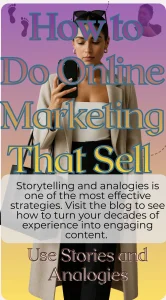
Here is something that separates experienced business owners from everyone else in the online space — and most of them don’t even realize they have it.
You have STORIES. Real ones. Decades worth of client transformations, business lessons, failures you recovered from, and wins that changed everything.
And those stories are the most powerful marketing tool that exists.
People do not buy products or services. They buy transformation. They buy the feeling of what life looks like on the other side of their problem.
And nothing communicates transformation faster or more powerfully than a real story told well.
Here is the simple story framework that sells without feeling salesy:
The Setup — Describe the situation before. Who was struggling? What was the problem? What had they already tried that didn’t work? Make it specific and relatable.
The Turning Point — What changed? What decision was made? What did they discover or implement? This is where your expertise enters the story naturally.
The Result — What does life look like now? Be specific about the outcome. Numbers, feelings, changes in behavior — all of it makes the transformation real and believable.
The Bridge — Connect the story to your reader. “If this sounds familiar, you’re not alone. And the same shift that worked for them can work for you.”
You have been telling great business stories for years around conference tables, on phone calls, and in client meetings.
It’s time to put those stories to work online where they can reach thousands of people instead of one.
Facebook Without the Confusion

Facebook gets a bad reputation in marketing circles these days — mostly from people who never learned how to use it properly.
The truth is Facebook remains one of the most powerful platforms for reaching seasoned business owners, and service-based entrepreneurs which is exactly who you are trying to reach.
The confusion around Facebook usually comes from one of three places: not knowing what to post, not understanding how the algorithm works, or trying to do too much at once. Let’s simplify all three.
What to post on Facebook — 5 content types that work:
Type 1 — Value posts. Share a tip, insight, or lesson from your years of experience. Short, clear, and immediately useful. These build authority and get saved and shared.
Type 2 — Story posts. Use the framework from Section 8. Client wins, business lessons, personal realizations — told in a way that connects and converts.
Type 3 — Question posts. Ask your audience something relevant to their struggles. Questions generate comments, and comments tell the Facebook algorithm to distribute your post to more people.
Type 4 — Behind the scenes. Show your process, your workspace, your thinking. People trust what they can see — and you don’t need a camera crew to make this work.
Type 5 — Promotional posts. Share your offer, your free resource, your service — but only about 20% of the time. The other 80% should be pure value.
How the Facebook algorithm actually works in plain language: Facebook shows your content to a small percentage of your followers first.
If those people engage likes, comments, shares, saves Facebook shows it to more people.
The more engagement your content generates, the more Facebook distributes it for free. Consistency and value are the two things that feed the algorithm what it needs.
Facebook is not dead. It is just misunderstood. And once you understand the syste, it becomes one of the most reliable ways to reach your ideal clients without spending a dime on ads.
One Daily Action That Builds Visibility

This is perhaps the most important practical section in this entire guid, because it answers the question that stops most business owners before they ever start: how do I do all of this without it taking over my life?
The answer is simpler than you think. One daily action. Consistent. Intentional. Focused. That is the entire strategy.
Think about compound interest in a bank account.
You don’t need to deposit thousands of dollars all at once, you need to deposit consistently over time and let the interest build.
Online visibility works exactly the same way. One post today plus one post tomorrow plus one post next week equals momentum.
And momentum is what the algorithm rewards.
Your one daily action menu — pick one per day:
Monday — Write and schedule one Facebook or LinkedIn post using a story from your experience.
Tuesday — Create and upload two Pinterest pins pointing to your most valuable blog post or opt-in.
Wednesday — Write and send your weekly email to your list — even if that list has 10 people right now.
Thursday — Engage with 5-10 posts in your niche. Comment genuinely. Build relationships. The algorithm notices.
Friday — Create one piece of content that can be repurposed — a tip, a quote, a mini lesson — and use it across multiple platforms.
Saturday — Review your analytics. What got the most engagement this week? Do more of that next week.
Sunday — Plan next week’s content in 20 minutes using ChatGPT so Monday morning is effortless.
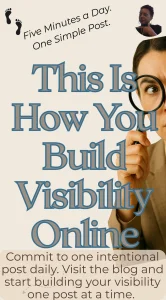
Five minutes a day. One intentional action. That is how visibility is built — not in a viral moment but in a thousand small consistent moments that compound over time into something unstoppable.
Let ChatGPT Handle Your Marketing

We have spent the last 10 sections building your foundation, your audience clarity, your content strategy, your platform understanding, and your daily action plan.
Now it is time to talk about the tool that ties all of it together and makes it sustainable for the long term.
ChatGPT is not a magic button. Let’s be honest about that upfront. It is a powerful tool, but like any tool, it only works as well as the system it operates within.
A hammer in the hands of someone who doesn’t know what they’re building produces very different results than a hammer in the hands of an experienced craftsperson.
You are the experienced craftsperson. ChatGPT is your most powerful new tool.
And what you are about to learn is how to set it up so it already knows everything it needs to know about your business, before you type a single word.
Here is what happens when ChatGPT is set up correctly for your business:
You open ChatGPT. You type two words: “Daily post.” And within seconds you have a fully written, on-brand, audience-specific social media post that sounds exactly like you — ready to copy, paste, and publish. No rewriting. No editing. No starting from scratch.
You type “Email sequence” and get a 5-part email series built around your specific offer, written in your voice, targeting your exact audience pain points.
You type “Pinterest pin” and get 10 SEO-optimized pin titles, descriptions, and CTAs, all pointing to the right destination, all using the right keywords, all ready to upload.
That is not a future possibility. That is what a properly trained ChatGPT brain does right now, today for business owners who have done the setup correctly.
The setup has 7 steps. Here is a preview of what those steps install:
Your target audience profile. Your brand voice and tone. Your offers and outcomes. Your conversion goals. Your content pillars. Your pain language. Your trigger command library.
Once those 7 things are installed — ChatGPT stops being a stranger and starts being a business partner that already knows everything about your business.
Everything you just read — the 7-step setup, the trigger commands, the trained brain that writes your content in your voice — is exactly what the free ChatGPT Cheat Codes for Small Business guide covers.
But here is what most people don’t realize until they’re inside the guide: the free version shows you the system.
The full setup gives you the complete trigger library, the master brain template, the repurpose engine, and the winner cloning system all built and ready to install.
Business owners are using this to reclaim 10+ hours every week. The free guide is your starting point. Click below and see exactly what you’ve been missing.
[Yes — I Want the Free ChatGPT Cheat Codes Guide →] → Flodesk link
Get the Free ChatGPT Setup
Let’s talk specifically about what the free ChatGPT Cheat Codes for Small Business guide includes — because understanding what you’re getting makes it impossible to say no.
This is not a generic list of prompts you can find on any blog. It is a structured setup system built specifically for business owners who want to use ChatGPT to create consistent, on-brand, conversion-focused content without spending hours in front of a screen.
Here is what the free guide covers:
How to install your audience profile into ChatGPT so every output automatically speaks to the right person. How to teach ChatGPT your brand voice using content you’ve already written.
How to set up your first trigger commands so one word generates a complete piece of content.
How to switch ChatGPT from engagement mode to buyer mode the single most important setting most people never touch.
And how to use the repurpose trigger to turn one idea into an entire week of content across every platform you use.
Who this is for:
This guide was built for business owners exactly like you — experienced, credible, busy, and ready to finally make online marketing work without it taking over your life.
You don’t need tech skills. You don’t need to understand AI. You just need 20 minutes and the willingness to follow 7 steps.
Who this is NOT for:
If you’re looking for a magic button that requires zero effort — this isn’t it. The setup takes 20 minutes.
After that? One word does the work. But those 20 minutes are non-negotiable.
The best time to set up your ChatGPT brain was the day you started your business. The second best time is right now.
Make ChatGPT Sound Like You
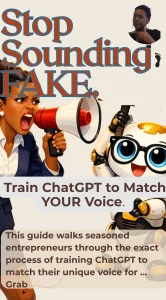
One of the most common frustrations business owners experience with ChatGPT is that it sounds like a robot wrote it
. Corporate. Generic. Stiff.
Nothing like the warm, experienced, authoritative voice you’ve spent decades developing.
That problem is 100% fixable — and fixing it is simpler than most people expect. The reason ChatGPT sounds generic is not because it’s incapable of sounding human. It’s because nobody told it how YOU sound. And until you do — it defaults to the average of everything it has ever learned, which is exactly as generic as it sounds.
Here is the 3-step voice training process:
Step 1 — Find your voice samples. Go back through your emails, your old blog posts, your social media captions — anything you wrote that sounds unmistakably like you. Pick 3-5 pieces that feel most authentic.
Step 2 — Upload and instruct. Paste those pieces into ChatGPT and say: “Study these pieces of writing. Learn my tone, my sentence structure, my vocabulary, and my communication style. From this point forward write in this voice.”
Step 3 — Test and refine. Ask ChatGPT to write something short in your voice and read it out loud. Does it sound like you? If not — tell it specifically what to adjust. Too formal? Say so. Too casual? Say so. ChatGPT learns from every correction.
After 2-3 rounds of this process most business owners are genuinely surprised — and a little unsettled — by how closely ChatGPT can replicate their natural voice.
Your voice is your brand. It took decades to develop. And now you can install it into an AI that will use it to create content for you around the clock — while you focus on the work only YOU can do.
One Word Triggers Your Whole Plan
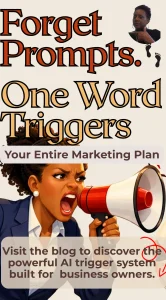
Everything we have built toward in this guide comes down to this moment.
The trigger system. Because once your ChatGPT brain is trained once it knows your audience, your voice, your offers, and your conversion goals, the entire game changes.
Instead of sitting down to write content, you sit down to trigger it.
Instead of spending 30 minutes crafting one post, you spend 30 seconds activating one. Even worse staring at a blank screen, you type two words and watch your entire marketing plan unfold in real time.
This is not an exaggeration. This is what a properly installed ChatGPT trigger system actually does.
Here are 7 triggers and what they activate:
“Daily post” — Generates a fully written, audience-specific, on-brand social media post ready to publish immediately.
“Clone winner” — Takes your best performing content and creates 5 new variations that replicate its success formula in fresh ways.
“Buyer mode” — Rewrites any piece of content to shift from engagement-focused to conversion-focused — speaking directly to purchase intent.
“Repurpose” — Takes one piece of content and turns it into pins, emails, captions, and blog outlines automatically.
“Pain finder” — Generates a list of the top pain points your audience is experiencing right now and suggests content angles for each one.
“Email sequence” — Creates a complete 5-part email series built around your specific offer and audience journey.
“My voice” — Reminds ChatGPT of your exact voice profile and recalibrates every output back to your authentic communication style.
One word. Trained brain. Real results. This is the system that serious business owners are using to reclaim their time, amplify their expertise, and finally build the online presence their business deserves.
Stay Visible on Autopilot
You made it to the final section — and that tells me something important about you.
You are serious. You are committed. And you are ready to do what it takes to build real, lasting online visibility for your business.
That combination of experience, commitment, and the right system is genuinely unstoppable.
So let’s talk about what staying visible on autopilot actually looks like — because consistency is the final piece of the puzzle, and it is the piece that turns everything we’ve covered into a long-term competitive advantage.
Here is what an autopilot content system looks like in practice:
Every Sunday evening you spend 20 minutes with ChatGPT.
You trigger your content calendar for the week 5 social media posts, 10 Pinterest pins, 1 email, and 2 blog outlines, all generated in your voice, for your audience, pointing to your offers.
You review, make minor adjustments, and schedule everything. Then you close your laptop and let the system run.
Monday through Saturday your content publishes automatically. Your pins drive traffic to your blog and opt-in around the clock.
Your email nurtures your list while you sleep. Your social media posts build authority and engagement without you checking your phone every hour.
Meanwhile you are doing what you do best serving your clients, growing your expertise, and building the business you’ve worked decades to create.
The 3 things that keep your autopilot system running:
Consistency — Show up on a schedule your audience can count on. Same days. Same quality. Same value. Consistency builds trust faster than any single viral post ever could.
Evolution — Pay attention to what works and do more of it. Pay attention to what doesn’t and adjust. Your content system should be getting smarter every single week.
Community — Build relationships, not just followers. Respond to comments. Ask questions. Celebrate your audience’s wins. The business owners who build real communities online create customers for life.
You showed up for 15 sections. You built the foundation. You learned the system.
Now for the easy part — staying visible while ChatGPT does the heavy lifting. The only question left is: are you ready to activate it?
You just spent time inside one of the most comprehensive online marketing guides written specifically for seasoned business owners and you earned every insight in it.
But here is the honest truth: reading about a system and having a system are two very different things.
The ChatGPT Cheat Codes for Small Business guide gives you the actual system. This includes the master brain template, the complete trigger library, the voice training framework, and the repurpose engine all built and ready to install in under an hour.
Business owners with decades of experience are using this to finally make online marketing work without it taking over their lives.
The free guide is your first step. The full system is your unfair advantage. You’ve waited long enough. Click below and activate yours today.
[I’m Ready — Give Me the ChatGPT Cheat Codes →] → Flodesk link
Thank you so much for spending this time with me today — it means more than you know.
If you walked away from this guide with even one idea that moves your business forward, then every word was worth writing.
You have spent years, maybe decades, building something real, something valuable, something that genuinely changes the lives of the people you serve.
The world needs to find you. And now you have the roadmap to make sure they do.
If you have questions, thoughts, or wins to share — drop them in the comments below.
I read every single one and I will personally respond. This community is built on real conversations, not just content.
And if this guide helped you — please share it with someone who needs it. You know someone. A fellow business owner who is brilliant at what they do but invisible online.
A colleague who keeps saying they need to “figure out this social media thing.” A friend who built something great and deserves to be found.
Send them this link. It might be exactly what they’ve been waiting for.
Be sure to follow me on Pinterest where I share up-to-date ChatGPT marketing strategies, Pinterest growth tips, and AI tools for business owners every single week.
The link is right here — [Follow PYTalkBiz on Pinterest →] — and I promise you will not regret it.
Don’t get stuck. Don’t get left behind. And don’t let another year go by with your business being the best-kept secret in your industry.
You are too experienced, too talented, and too valuable for that.
Now go show up. The right people are already looking for you.
— Deborah
Leave a Reply